Copper Tasks lifecycle overview
Copper: Task Lifecycle
Here is a quick illustration of a task lifecycle
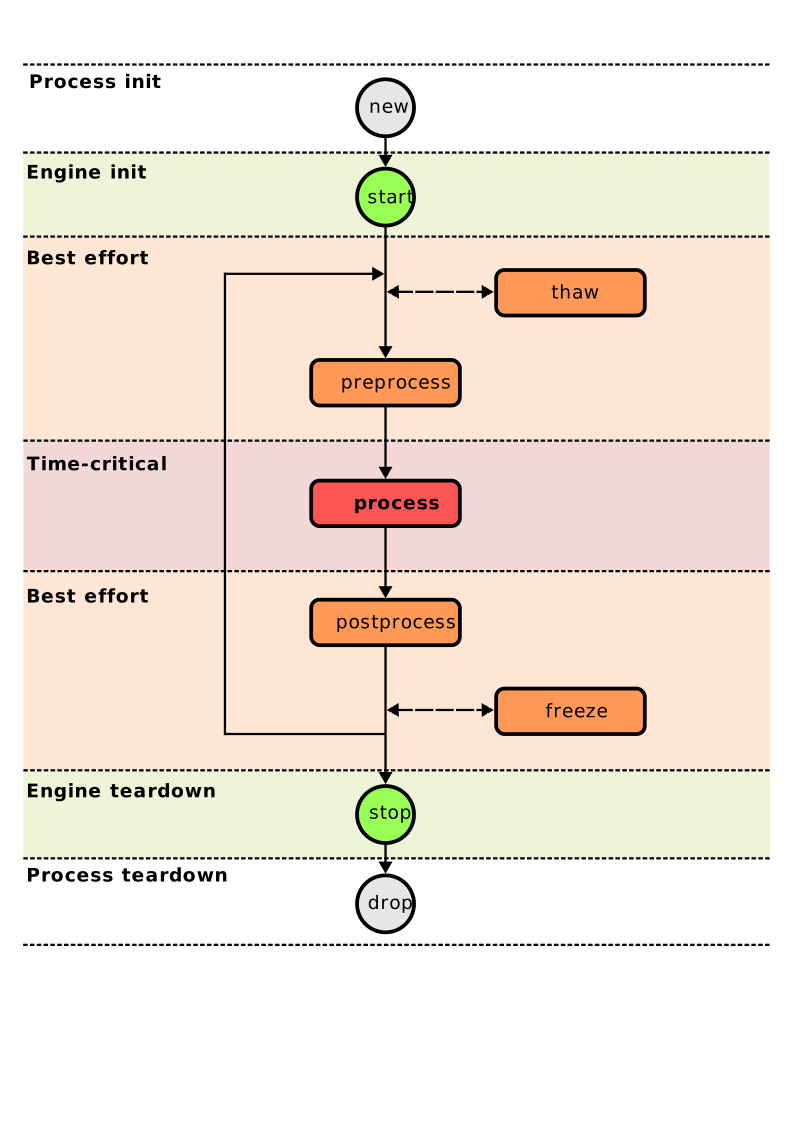
The framework is designed to give as many chances as possible for the tasks to do its heavy lifting out of the critical path.
- The time critical part will try to be scheduled as back to back as possible between tasks on the same thread (low latency / low jitter)
- The best effort part will try be scheduled by packing them to minimize the interference with the critical path (high throughput / high jitter).
In the critical loop, no allocation should occur, messages are pre-allocated and reused.
Latched state updates
For low-rate "sticky" state, do not keep re-sending the full value every cycle and do not assume Copper will implicitly remember the previous output. Instead, send a payload that explicitly describes how downstream state should evolve.
Copper provides:
CuLatchedStateUpdate<T>withNoChange,Set(T), andClearCuLatchedState<T>as the consumer-side cache
Semantics:
NoChangemeans "keep whatever value was already latched"Set(T)means "replace the latched value with this one"Clearmeans "the previously latched value is no longer valid"
Typical producer pattern:
- emit
Set(...)when calibration / transforms / metadata first become available - emit
NoChangeon later cycles while the cached value stays valid - emit
Clearif the cached value must be invalidated
Typical consumer pattern:
- store a
CuLatchedState<T>inside the task struct - when an update message arrives, call
state.update(update) - read the cached value with
state.get()and skip work until it exists
pub struct DepthProjector {
    calibration: CuLatchedState<Calibration>,
}

fn process(&mut self, _clock: &RobotClock, input: &Self::Input<'_>,
           output: &mut Self::Output<'_>) -> CuResult<()> {
    if let Some(update) = input.payload() {
        self.calibration.update(update);
    }

    let Some(calibration) = self.calibration.get() else {
        return Ok(());
    };

    // Use the cached calibration until a future Set(...) or Clear arrives.
    output.set_payload(project_depth_with(calibration));
    Ok(())
}
This is useful for calibration bundles, static transforms, map updates, and other state that is usually unchanged but must still be deterministic in logs and replay. Because the updates are part of the message stream, replay and resimulation see the same state transitions as the live run.
Note on freeze / thaw: Copper periodically serializes component state so replay can seek from a nearby keyframe instead of replaying from the beginning. Keyframe capture does not stop or drain the graph, including background and parallel-rt work, but remains deterministic on replay. Because freeze() runs at the component's normal point in the execution wave, implementations should be side-effect-free and must not allocate on the real-time path.
Stateless transform tasks
CuStatelessTask requires Reflect + Send + Sync and does not require
Freezable. Its per-cycle preprocess, process, and postprocess callbacks
receive &self, so the runtime can invoke them concurrently for different
CopperLists. Construction, start, and stop remain exclusive lifecycle
operations.
The runtime records an empty keyframe component for a stateless task and leaves
its instance unchanged when restoring a keyframe. State that affects later
outputs belongs in a CuTask implementation with freeze and thaw preserving
that state. CuSrcTask, CuTask, and CuSinkTask still require Freezable; an
empty implementation is sufficient when they have no state to snapshot.